
Ask ten people what a healthy breakfast looks like and you'll get ten different answers - oats, idli, a smoothie, black coffee and willpower. But ask a nutritionist, and one thing comes up almost every time: most breakfasts, especially the traditional South Indian and North Indian staples many of us grew up on, are carbohydrate-heavy and protein-light. And that imbalance is quietly working against you all morning.
Why breakfast protein matters more than people think
Protein isn't just for people trying to build muscle. At breakfast specifically, it does three jobs that carbohydrate-only meals can't:
- It slows down digestion, which stabilizes blood sugar: A breakfast that's mostly refined carbs - white bread, plain poha, sugary cereal - gets digested fast, causing a quick glucose spike followed by an equally quick crash. That crash is often what people mistake for "just being hungry again" by 10:30 AM, when it's actually a blood sugar dip.
- It keeps you full for longer: Protein is the most satiating macronutrient - more so than carbs or fat, gram for gram. A protein-rich breakfast measurably reduces how much you eat later in the day, simply because your body isn't sending hunger signals as early.
- It supports everyday recovery and repair: Muscle tissue, immune function, hormone production - protein is a building block for all of it, and breakfast is when your body has gone longest without a supply, after the overnight fast.
The gap in typical Indian breakfasts
This is where a lot of well-intentioned morning meals fall short. Consider some common options and roughly where they land:
- Poha or upma: Light, quick, comforting, but overwhelmingly carbohydrate with very little protein unless deliberately loaded with peanuts, sprouts, or paneer.
- Idli and dosa: Fermented and easier to digest than many alternatives, but again carb-forward, with the accompanying sambar contributing only modest protein.
- White bread toast or bakery items: Often the fastest option on a rushed morning, and nutritionally the weakest, offering refined carbs with minimal fiber or protein.
- Just coffee or tea: Extremely common, and functionally a decision to skip the meal's nutritional job entirely.
None of these are "bad" foods. The issue is what's missing, not what's present. A breakfast built entirely around rice, refined flour, or fried snacks is optimized for taste and speed, not for how your body actually needs to be fueled for the next five to six hours.
The 4-Pillar Balanced Breakfast Framework
The nutritionist-approved composition for lasting morning energy:
Why this is harder than it sounds on a normal weekday
Knowing what a balanced breakfast should contain and actually assembling one at 7:15 AM before a commute are two very different things. Sprouting moong, soaking oats, pressing paneer, portioning nuts, balancing a plate - none of it is difficult in isolation, but it adds up to prep time that a working morning in a city like Bangalore rarely has room for.
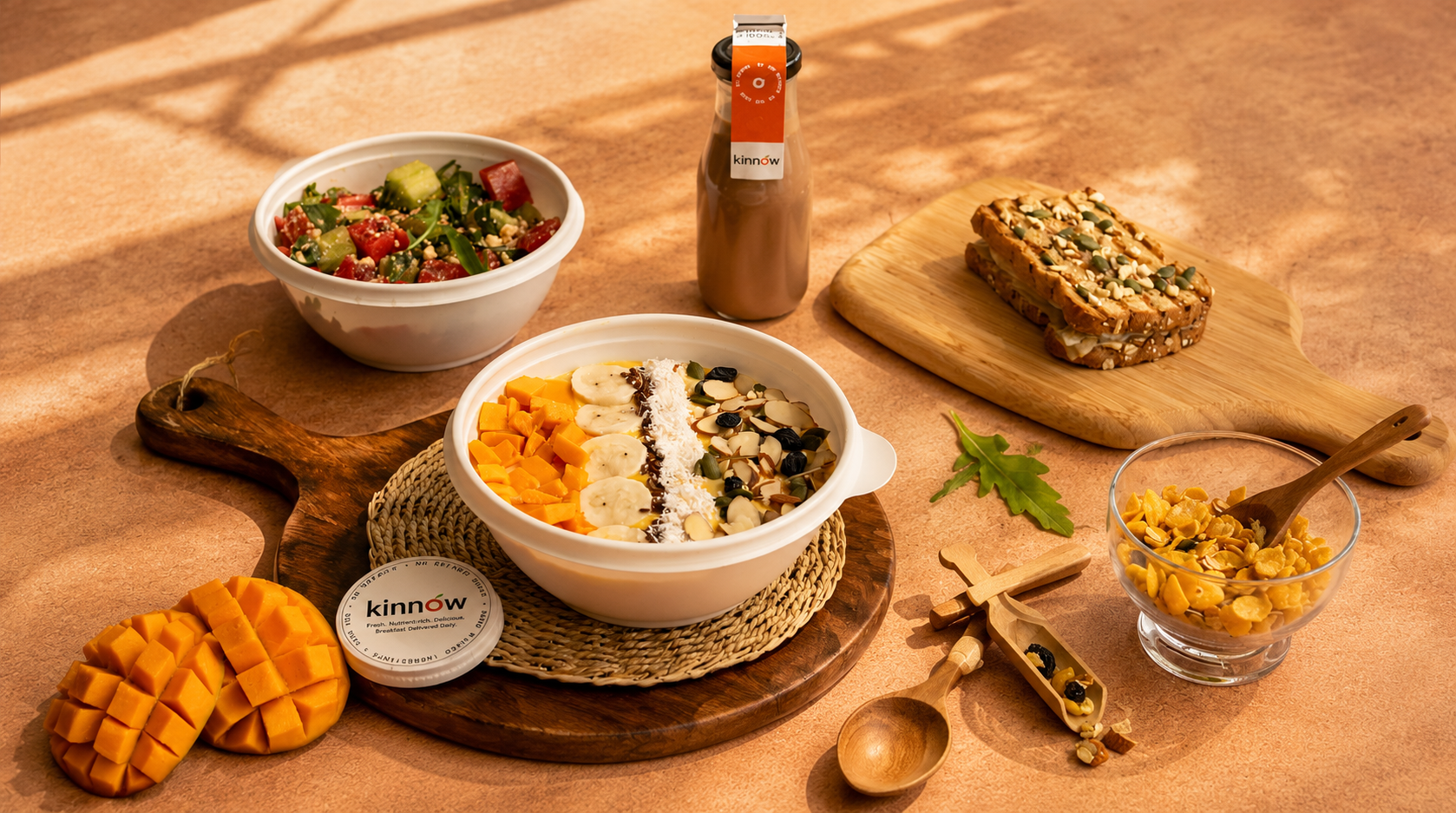
This is the exact gap Kinnow was built around. As a health-first food delivery platform, our breakfast subscriptions are designed nutritionally from the ground up - not as an afterthought to taste, but as the starting point. Every meal is built to include a real protein source, sensible carbohydrates, and the kind of fiber and fat balance that keeps you full and steady, not spiking and crashing by mid-morning.
"We're proudly 100% vegetarian across all 100+ options on the platform. Every protein source - from paneer to sprouts to lentils - is natural, clean, and uncompromised."
Because we run our own kitchens rather than outsourcing to third-party vendors, we control exactly what goes into every meal - no guessing, no compromise between what's convenient to prep and what's nutritionally sound. And with a 20-minute freshness promise from our own delivery fleet, a properly balanced breakfast doesn't cost you the fifteen minutes you don't have.
Our mission is straightforward: to help India eat nutrient-rich, not just calorie-rich. That starts with the first meal of the day, and it starts with getting the protein question right.
The takeaway
If your breakfast leaves you hungry again by 11 AM, it's rarely a willpower problem - it's usually a protein problem. The fix isn't eating more food, it's eating better-composed food. And on the mornings when there's no time to build that plate yourself, that's exactly the problem a real, freshly made, protein-balanced breakfast delivered to your door is meant to solve.